Self-Publishing on Amazon: What I Wish I Knew Earlier
When I first sat down to self-publish my first book on Amazon, I treated the process like a traditional publishing house project. I focused on the "art" of writing, the "perfection" of the cover, and the "dream" of becoming an author. I thought if I just wrote a good book, the audience would magically appear. I was wrong.
The reality of Kindle Direct Publishing (KDP) is much closer to running a small e-commerce store than it is to traditional literary endeavors. It is a game of keywords, reader expectations, and problem-solving. If I could go back and whisper a few truths to my past self, here is what I would say.
Phase 1: Stop Writing for Yourself
The biggest trap I fell into was writing what I wanted to read, rather than what the market was actually looking for. Passion is important-you cannot sustain the effort of writing a book if you do not care about the topic-but passion alone does not sell books.
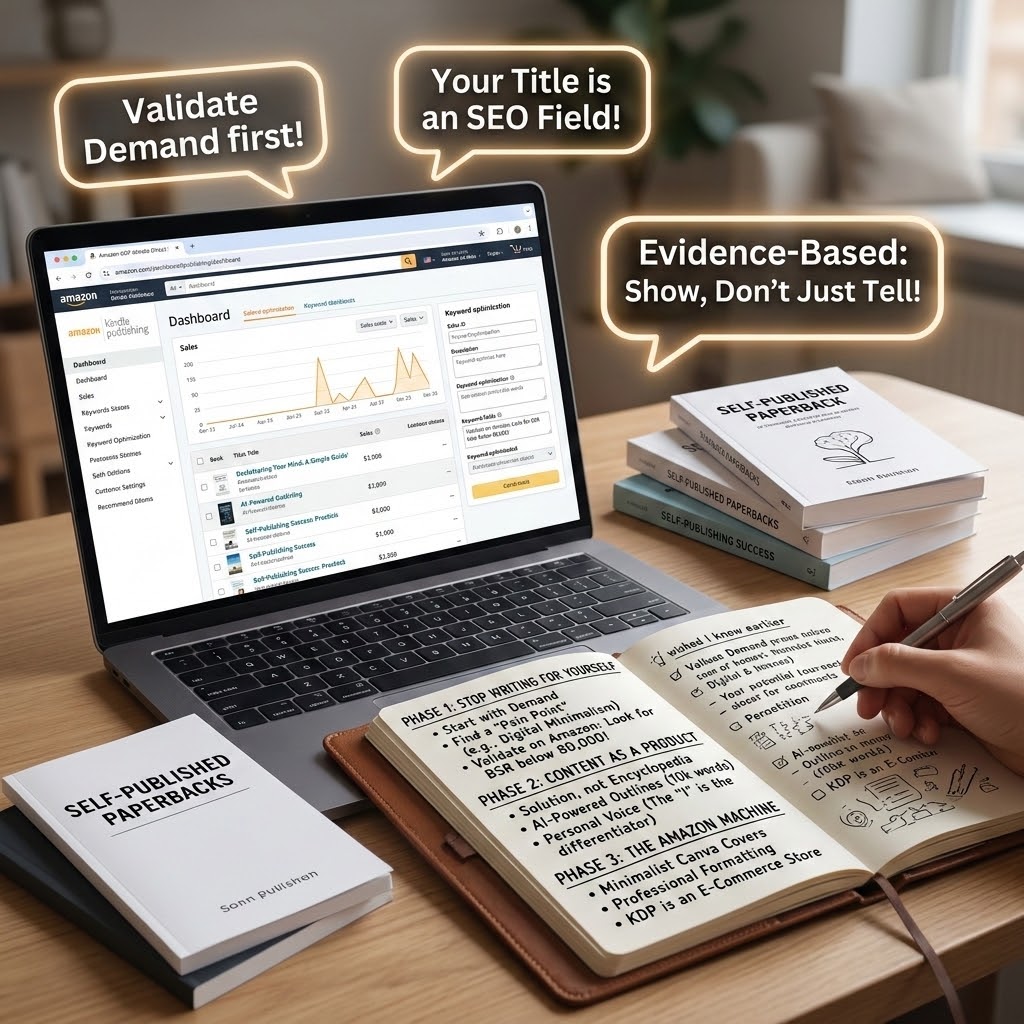
I learned to start with demand. Now, before I even draft an outline, I look for "pain points." I ask: What problem is someone having at 2:00 AM, and how can my book solve it? Whether it is digital minimalism, mental health strategies, or specific career skills, you need to find a niche where people are already searching for answers.
I also learned the importance of "validating on Amazon." It is not enough to have a good idea. You need to see if people are spending money on that topic. When I search for a potential topic, I look for books that are already selling-specifically, books with a Bestsellers Rank (BSR) below 80,000. If there are no books selling well in that niche, it might mean there is no market. If there are dozens of books selling well, it means the audience exists. Your job then is not to reinvent the wheel, but to offer a simpler, more direct, or better-organized solution than what is already there.
Phase 2: Content Creation as a Product
Once you have identified the problem, your book needs to be a "solution product." I used to think of books as encyclopedias-I wanted to pack as much information as possible into every chapter. That is a mistake. Readers today are busy. They do not want an encyclopedia; they want a shortcut.
I now use AI to generate detailed outlines for 10,000-word books. This length is perfect for a concise, actionable guide. The structure is non-negotiable: an introduction, chapters with clear subtopics, and, most importantly, actionable exercises. If the reader does not walk away with something they can do, I have failed.
The writing process itself has changed for me. While AI is a fantastic tool for generating drafts and overcoming the blank page, it is just a starting point. If you copy and paste AI content directly, readers will know. It feels flat, generic, and lifeless. I edit everything to add my personal voice, my own failures, and my specific observations. The "I" in my writing is my biggest differentiator. It turns a generic guide into a personal mentorship.
And then there is the title. I stopped trying to be clever or poetic. "The Journey Toward Inner Peace Through Strategic Discipline" is a terrible title for Amazon. "Decluttering Your Mind: A Simple Guide" is much better. It tells the reader exactly what they are getting and includes the keywords they are actually typing into the search bar. Never sacrifice clarity for creativity in your title.
Phase 3: Design, Publishing, and the Amazon Machine
I wasted weeks on cover design before learning a simple truth: minimalist, professional, and readable covers win. I use Canva now. I stick to free, clean templates. If the thumbnail looks good on a phone screen, it is good enough. Do not overthink the cover; if it looks messy or confusing, readers will scroll right past it.
Formatting is the unglamorous side of publishing. Getting a document into a professional digital layout for KDP is tedious but necessary. I use Google Docs to keep everything clean and organized. Amazon's KDP platform handles the rest. It is a massive, efficient machine. Once you upload, you are tapping into a global customer base. They handle the payment processing, the digital delivery, and the customer service. You do not have to worry about selling; you just have to worry about providing value.
The "Evidence-Based" Approach: My Personal Experiment
Recently, I started experimenting with a "transparent" publishing style. I decided to link my actual working documents-like my Trade Journals and my Master Prompts-directly in my books. At first, I was nervous. I thought, "Why would I show people the messy sausage-making process?"
But the feedback surprised me. For a beginner audience, seeing the actual, messy data is a huge trust-builder. It moves the conversation from theory to reality. It proves that the system works. It's much easier to learn by looking at a real spreadsheet of my progress than by reading a theoretical description of how someone else thinks I should work.
This "AI Partner" narrative-where I show the reader exactly how I "program" my AI to help me-is the most unique part of my current work. It invites the reader into my process.
However, be careful. If you do this, you must "sanitize" your files. I've learned to create "Template Versions" of my live documents. You do not want your personal account numbers, private emails, or full legal names ending up in a public file. And always double-check your links. A broken link in a digital book is a frustrating experience for a reader. If you move a file in Google Drive, the link dies. It's a good practice to use a URL shortener or a permanent page on your site to redirect those links, just in case you ever rearrange your file structure.
Conclusion
Self-publishing is not about becoming a famous author. It is about becoming a useful resource. If you focus on solving one specific problem, validating that people actually want that solution, and presenting it with a clear, honest, and personal voice, you can build a library of work that provides value long after you have written the last word. Stop trying to write the perfect book and start trying to write the most useful book.