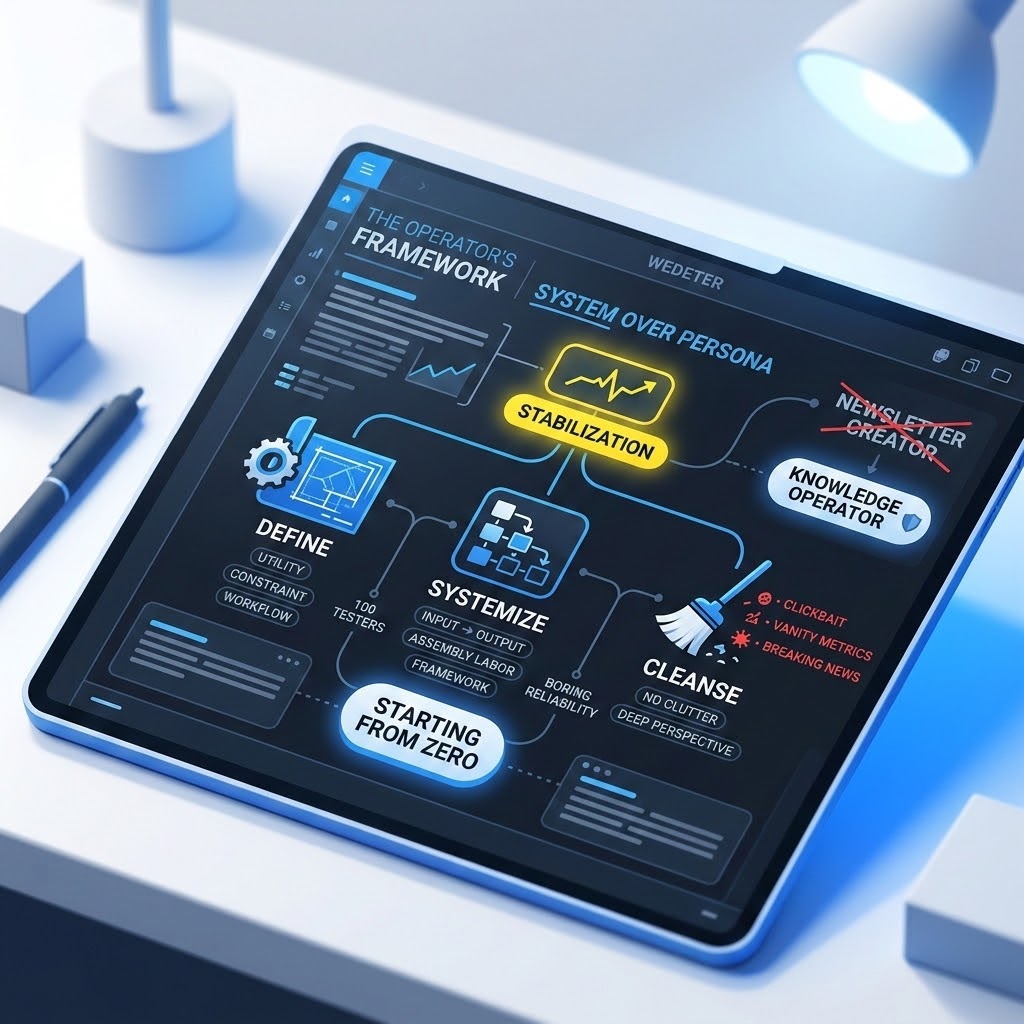
Most people treat "starting from zero" as a panic-inducing condition. When I look at a blank screen or a new project, I don't see a void that needs to be filled as quickly as possible. I see a controlled position. Starting a newsletter in 2026 is no longer about "growth hacking" or finding the right platform to host your content. It is about defining the structure of your output before you ask for a single person's attention. If you rush to fill the space, you will only replicate the same noise you are trying to avoid. Here is how I would build a newsletter from the ground up, using the same "define before you expand" framework I use for every reset in my professional life.
The first mistake I see creators make is debating between Substack, Beehiiv, Ghost, or a custom site. They treat the platform as the structure. In my experience, the platform is just the utility; the structure is your process. Before I sign up for a single service, I define what the newsletter actually does for the reader. If you cannot explain the value proposition in one sentence, you aren't ready to launch. You are just ready to add to the noise.
At the beginning, "zero" is your greatest advantage. You aren't beholden to existing subscribers who expect a certain type of content, and you don't have an advertising model that dictates your tone. Use this window to define the parameters:
There is a dangerous urge to chase subscriber counts in the first 90 days. We are conditioned to see big numbers as proof of validity. In my experience, early subscribers are often a liability if you haven't built the structure to support them. If you launch and hit 1,000 subscribers, you are now obligated to fulfill that promise every week. If your system isn't robust, you will start cutting corners, outsourcing to low-quality AI, or writing filler just to hit the deadline.
I would approach this differently. I would view my first 100 subscribers as a testing group, not a vanity metric. I would ask myself:
If the answer to the last point is "draining," you need to fix the internal system before you add more subscribers. Expanding on a broken system just accelerates the collapse.
When starting from zero, the instinct is to copy what the "successful" newsletters are doing. I look at those massive, bloated newsletters and I see technical debt. They carry social media engagement tactics, clickbait headlines, and repetitive news-aggregation filler. I refuse to carry any of that.
For a newsletter to be sustainable in 2026, it must provide what the algorithmic feed cannot: deep, experience-based perspective. Here is what I am clearing out of my process:
I don't start by writing the first issue. I start by building the "input-to-output" pipeline. A newsletter is just a machine that processes information. If the inputs are garbage, the output will be garbage. I spend the first two weeks just gathering and refining my inputs:
First, I set up a dedicated capture system. Every idea, observation, or piece of data I find throughout the week goes into a central database. I do not try to write the newsletter in one sitting. I write it in pieces throughout the week. This shifts the work from "creative labor" (which is draining) to "assembly labor" (which is manageable). By the time I sit down to assemble the final version, 80% of the work is already done.
Second, I define a clear format. I use the same heading structure every week. This creates a psychological "rhythm" for the reader and a physical structure for me. It removes the need to make creative decisions about "how to start" every single time I hit publish. Freedom within a framework is how you scale output without burning out.
Once the system is live, the goal is not to go viral. The goal is to reach a state of "boring reliability." I want to be the newsletter that the reader knows will arrive on time, every time, with a consistent quality level.
This is where most creators fail. They treat their newsletter like an artist's project, relying on inspiration to get it done. I treat it like a service. If I am not in the mood to write, the system-my database of notes, my predefined template, my scheduled deadlines-takes over. If your output depends on your mood, your newsletter is not a business; it's a hobby.
I would limit my growth at this stage. I would not buy ads. I would not run referral contests. I would focus entirely on "word of mouth" via high-value content. If the content is good enough, the expansion will happen naturally. If you have to force-feed growth through incentives, the foundation isn't ready to support the weight.
Finally, I would reject the label of "Newsletter Creator." It's too broad and too self-centered. It focuses on the persona rather than the product. I would identify as a "Knowledge Operator." The focus is on the curation, the distillation, and the practical application of the knowledge I am sharing.
When you detach your identity from the platform or the subscriber count, you become harder to destabilize. If the platform changes its algorithm, you aren't devastated because you own the process. If subscriber growth plateaus, you aren't panicked because you know the quality of the work is solid. By starting from zero and building with control, I create a structure that isn't dependent on the market's approval to exist.